Tampilkan postingan dengan label Philadelphia vireo. Tampilkan semua postingan
Tampilkan postingan dengan label Philadelphia vireo. Tampilkan semua postingan
Vireotown
 Red-eyed vireo
We have three species of vireos that nest on our farm here in southeastern Ohio: red-eyed, white-eyed, and yellow-throated. There are three others that we see each spring and fall, just passin' through: blue-headed (formerly solitary and I can't seem to remember to use the "new" name), warbling, and Philadelphia. If we really stretched our birding fantasy list to the extreme I suppose we could one day see a Bell's vireo here at Indigo Hill, but if we do, that sighting will get its very own blog post.
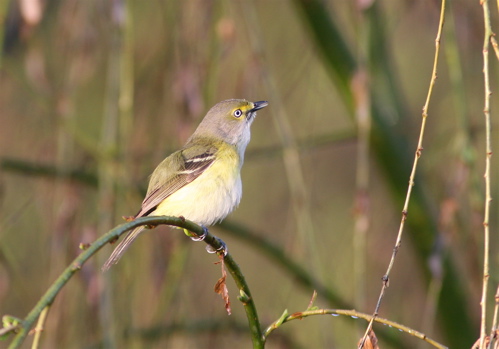 White-eyed vireo
White-eyeds sing a ton during courtship, then not at all during nesting it seems. I wonder if the tree-top-loving red-eyeds and yellow-throateds sing more regularly (or the white-eyeds less) due to their relative exposure to predators. A red-eyed vireo singing in the top of a tulip poplar is very hard to find. A white-eyed may be skulking in the shadows, but it's usually at eye level or below in a patch of brushy habitat. Does this make them more susceptible to predators?
 Yellow-throated vireo
Now that fall migration has started, these vireos can still be heard singing, though with nowhere near the intensity of the earlier seasons. The other notable behavior of fall migration is the aggressiveness of the red-eyed vireos. They zip and swoop from tree to tree, often chasing other birds. I imagine these other birds thinking "What the heck? Leave me alone!" I'm sure this behavior has something to do with the fluctuation in hormone levels brought on by the end of the breeding season and the onset of fall migration.
The red-eyeds remind me of teenage boys who, when they find themselves just standing around doing, nothing get the sudden urge to punch a nearby shoulder. This punch often elicits another, and so on.
Our vireos' aggressiveness sometimes pays nice dividends, like this morning when a pair of (probably young) red-eyeds chased two warblers out of deep cover in our sycamore tree: one was an adult male black-throated blue (my favorite North American warbler) and the other was a yellow-throated warbler—both firsts for this fall.
 Philadelphia vireo
Philly Vireo Invasion
 Fall provides the best birding on our farm in southeastern Ohio. And the middle weeks of September are the peak of fall passerine migration. Among the birds we see more regularly in the fall than spring is the Philadelphia vireo. This morning, when the sun started warming the birch trees in our yard, the foliage came alive with foraging warblers and vireos. By far the most numerous species was the Philly vireo.
 Several birds (there were at least 10 Philly vireos) paused long enough in the birches to have their picture taken. Though these images aren't great, they represent the pinnacle of my Philly vireo photography career.
 There is something about the face of a Philly vireo that makes it instantly recognizable to me. The gray cap, white lines curving above and below the large, black eye, and the somewhat stubby-appearing bill all combine to help me put a name on this gray-yellow-green leaf-skulker whenever I see it.
 The field guides will point to the yellow-washed underparts and the dark spot before the eye (or in some cases a thin black line through the eye). But this species can vary in appearance. Pale Phillys can be easily confused with warbling vireos.
Also making an appearance this morning, in the few short hours before I headed in to work at BWD: magnolia, Tennessee, Nashville, black-throated green, Cape May, bay-breasted, blackpoll, and Blackburnian warblers and American redstart. I heard a singing black-and-white warbler, but did not see it.
Langganan:
Postingan (Atom)


