Tampilkan postingan dengan label bird photography. Tampilkan semua postingan
Tampilkan postingan dengan label bird photography. Tampilkan semua postingan
One Shot: Kenai River, Alaska
 We rafted down the Kenai River today near Soldatna, Alaska. I took about 375 shots with my Canon 30D. Most were bad—out of focus, overexposed, poorly framed. But this one, of a flying adult bald eagle, came out all right. It's my One Shot post for today.
 Special thanks to all my friends at the Kenai Birding Festival, and especially to our drift-boat guide Ed O'Connor of Advantage Angling.
Birding Goose Pond, Indiana

Those of us who have been watching birds for a few decades have witnessed the steady decline of many of our birds and the ravenous consumption of natural habitat by the expansion of our human population. It can be mighty depressing.
And this is why, when we witness the opposite happening with birds and their precious habitat, it's not only uplifting, it gives us hope that we CAN be good stewards of the planet and the birds we love so much. Here's an example of if you preserve it/restore it the birds (and birders) will come.
 The sky above Goose Pond was constantly filled with birds. These are sandhill cranes, mostly.
Last weekend I was a guest instructor at a nature photography/birding workshop offered by Roberts Camera of Indianapolis and held at the Goose Pond Fish & Wildlife Area near Linton, Indiana. Goose pond is a glacial basin that, for years, was drained and pumped so it could be farmed. In 2005 the owner of the land—which totaled about 7,500 acres—sold the land to the state of Indiana's Department of Natural Resources.
The DNR, with the help of a variety of conservation partners, began restoring the area to a more natural wetland habitat. Almost immediately birds started showing up, including thousands of sandhill cranes. The people of Linton/Greene County, IN noticed and started a nature festival focused on Goose Pond, called Marsh Madness, which is being held on March 3, 2012. The habitat has only been restored and open for less than a decade, yet it's attracting loads of visitors for birding, fishing, hunting, boating, and other outdoor pursuits.
Our event was a week prior to the actual festival, but the birding was fabulous—50 species of birds were found easily during the four separate sessions we ran on Saturday and Sunday. Photographer David FitzSimmons and a team of experts from Roberts Camera handled the photography sessions while I held down the birding outings. Most of the attendees were photographers first, and some were even experiencing bird watching for the first time, which was great. I love nothing more than putting the spotting scope (in this case a totally sweet loaner 65mm Leica spotting scope from Jeff Bouton at Leica Sport Optics) and hearing someone's breath literally leave their body in a gasp when they see the magnified image. We had a lot of those moments at Goose Pond.
 One of the gasp moments at Goose Pond was a zoomed-up scope view of this bald eagle's nest.
The next time Roberts Camera will hold its Marsh Madness Photography/Birding Workshop is in spring 2013. If you're interested in getting better at taking bird photos, I'd suggest checking it out.
Next post: "Hey! What's that big white bird?"
Kingdom of Kingfishers!
 Smyrna kingfisher in the pre-dawn fog at Hula-Agamon Park.
I was in Israel on a birding tour over the Thanksgiving holiday this year, attending the Hula Valley Bird Festival. The trip was amazing and amazingly birdy almost everywhere we went. For this post I'm going to highlight the incredible density of kingfishers we encountered.
But first some background!
I'd been to Israel once before, in the late 1980s. I'd be shocked if any readers of this blog recall my article about that trip, written for Bird Watcher's Digest and published in the September/October 1985 issue of BWD. That was my first-ever BWD article written about my first-ever official overseas birding trip! Both times I had to do some careful thinking and planning both because Israel is a long way away and because it's in a part of the world that's often in the news, usually due to political unrest between neighbors. Fortunately on both trips, each lasting more than a week, any concerns I had were unwarranted—the people were friendly, the neighbors were neighborly, the weather was wonderful, the landscape was beautiful and the birds were beyond expectation.
Consider yourself warned that I'm working on another Israel article, along with a podcast, and a gallery of images for the not-so-distant future for BWD. Now back to the kingfishers.
Located as it is in the middle of the arid, mostly desert Middle East, Israel would be no more bird-rich than its neighbors except for one major factor: water. Water flows through this country from north to south and it is channeled and used in a variety of ways, especially for agriculture. Wherever this water occurs, so do birds, especially water-loving birds like the kingfishers. We encountered three kingfisher species during our time in the Hula Valley in northern Israel and on short trips out from the valley in all directions: the common kingfisher, the pied kingfisher, and the white-throated or Smyrna kingfisher.
 Pied kingfishers at a fish farm.
Israel has a lot of fish farms. These fish farms have a lot of fish, which means they also have a lot of fish-eating birds. Nearly every day during our birding trip we stopped at some set of man-made ponds, reservoirs, fish farms, or water-treatment facility. We'd scan the water and shoreline for birds, often looking past the number of kingfishers present. In the image above, there are eight pied kingfishers on a single perch. We sometimes would see twice that many or more perched on sticks and posts along one side of a pond. It was nuts! Only a few individuals were so intent on fishing that they allowed close approach. This is likely a result of the bird-scaring efforts that the fish farmers have to do in order to control the loss of their "crop" to the crops of birds.
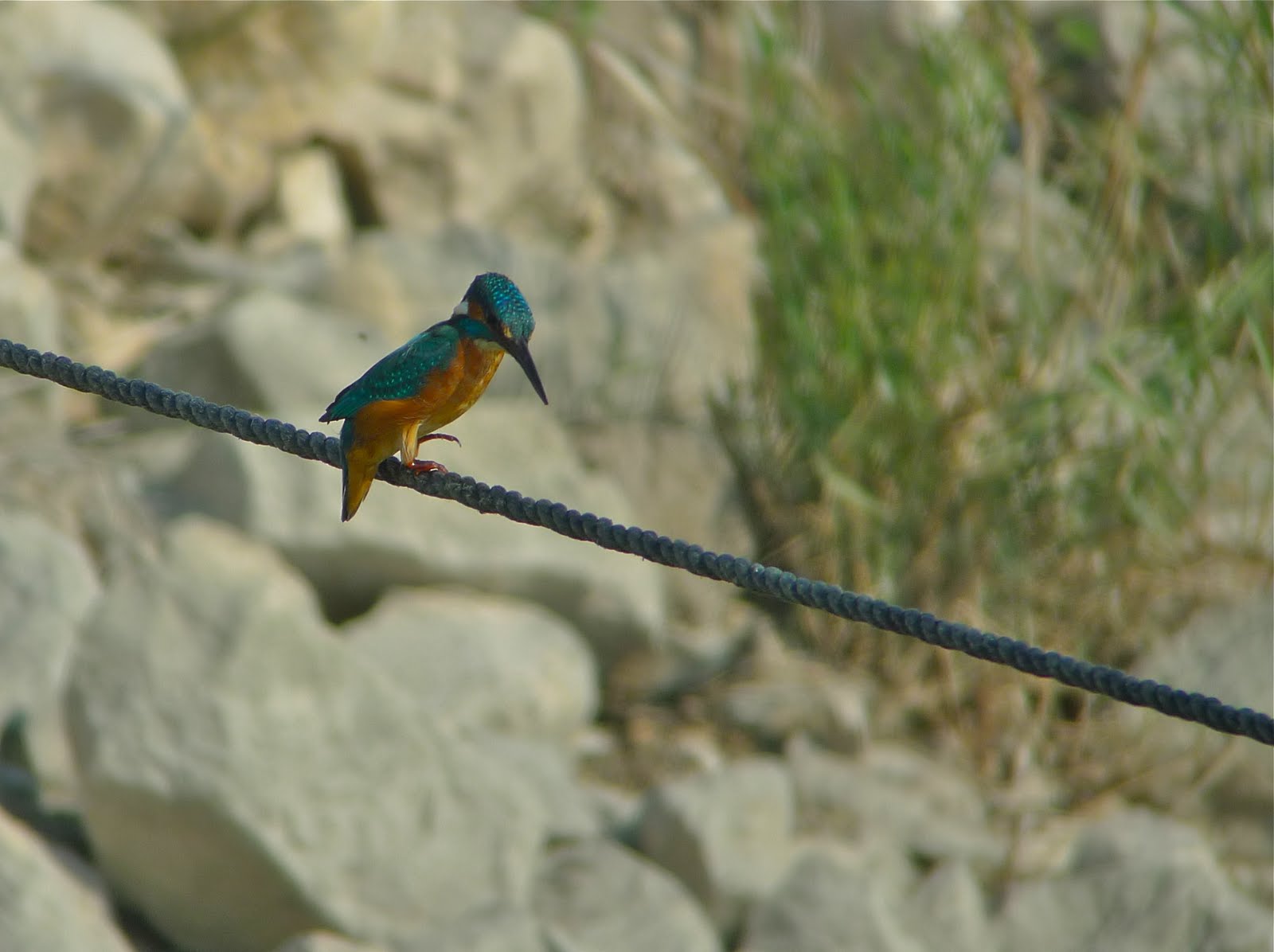 The small common kingfisher, which is widespread in Europe, seemed to be the most shy. We'd normally catch brief glimpses of one as it zipped low over the water from one hidden perch to another. Or we'd spy their glimmering iridescent plumage at a distance as we were scanning with our optics.
 White-throated kingfisher, aka Smyrna kingfisher, aka white-breasted kingfisher.
The largest of the three kingfisher species we encountered is the white-throated kingfisher, also often referred to as the Smyrna kingfisher. These stunning and bold birds were noisy enough to make their presence known even when they were out of our direct sight.
 The pied kingfisher is a study in blacks and whites as its name implies. Slightly smaller than the white-throated kingfisher, the pied was our most frequently seen kingfisher species. Both of the larger kingfishers could regularly be seen away from water, hunting lizards and geckos from a watching perch.
Water brings life to the desert and attracts living things from all directions. It is the kingdom of kings and the kingdom of kingfishers, too!
Here are a few of my better kingfisher images from last week's trip. Enjoy!
 A pied kingfisher launching from a perch over water in the Hula Reserve Park.
 Hovering pied kingfisher at Ma'agan Michael along the Mediterranean.
 No one knows why this species is named white-throated kingfisher.
 Common kingfisher held by a staff member at the Hula-Agamon ringing (banding) station.
 Pied kingfisher at Ma'agan Michael.
Bee-Buzz Haiku

Your wings are not blue
While others sing more sweetly
You just say "Beee-buzzzz!"
* adult male blue-winged warbler digiscoped at Long Point Meadows near Fayetteville, WV, May 2011.
Trip from Bountiful

While speaking and guiding at The Great Salt Lake Bird Festival in May, the kind folks at the festival put me up in Bountiful, Utah. The hotel was lovely, but being between two busy highways it was not so birdy.
When I found myself with a free morning, I was determined to find some birds to enjoy and to photograph, so I enlisted my new friend Valerie a festival volunteer and local Utah birder, to help me find a good, birdy spot. Also joining us was a longtime friend, birder, and Rio Grande Valley Birding Festival raconteur Marci Fuller. Marci was seeking a Virginia's warbler. I was seeking some bird photo opps. Valerie was kind enough to take us to a real gem of a spot called Willard Bay State Park, north of Salt Lake City and Bountiful. It turned out to be a bountiful trip!
As soon as we got out of the car our ears were assaulted by bird song. Yellow warblers were singing from every direction. Lazuli buntings and black-headed grosbeaks vocalized from the cottonwoods, and a host of other noisemakers chimed in. And then I heard one of those calls that you KNOW you know, but you can't quite place it. Know what I mean? This happens to me every spring.
Cavorting along the branches of a tree with lots of apparently tasty buds was the calling bird and, when I saw what it was, I jumped up and down, squealing, like a six-year old girl who's just been given a pony!
"Hey! EVENING GROSBEAK! Yes! Holy #@$%&*#$%! I KNEW I knew that call! How OSSUM is THAT BIRD!"
Then (I hope not because of my antics) the flock flew far away and I had to wait for a couple of hours before we relocated a photograph-able bird (below). I love evening grosbeaks, in case you were wondering. The first year of publishing Bird Watcher's Digest in our home in Marietta, Ohio, we had a huge finch invasion with loads of evening grosbeaks at the feeders, so they've always occupied a special place in my heart.
 Male evening grosbeak.
Another song caught my ear—familiar, but not as familiar as the grosbeak's. It was a dark-plumaged fox sparrow singing a slightly weird song. We listened to his amazing melodic phrases. Fox sparrows pass through my home turf in spring and fall, only occasionally stopping long enough to be heard singing. In my opinion they are an underrated singer.
 Fox sparrow.
 Valerie and Marci scanning the woodland edge.
 California quail.
Several American white pelicans were soaking up the warm morning sunshine in a small embayment. They hardly paid any attention to us.
 American white pelican.
 Clark's grebe.
A very cooperative male black-headed grosbeak sang for us in the sun. Seeing this stunning bird so well through my scope reminded me that we can get blasé about our familiar local birds. I recall wondering about a European friend's overwhelming joy at seeing a northern cardinal on my farm in Ohio. There are no all-red birds in Europe, so seeing one for the first time made his eyes pop out. I felt that way about this black-headed grosbeak—so handsome, especially to my eastern eyes.
 Male black-headed grosbeak.
It's funny how easily we may overlook common birds. A pair of American robins was building a nest in the interpretive signage near our parking lot. They seemed wary, as if not wanting to tip us off to the nest's location. Since I began dabbling in various forms of bird photography, I think I've paid a bit more attention to common birds, especially if they are being cooperative enough to photograph.
 American robin, adult male.
 Valerie (left) and Marci laughing at my evening grosbeak happy dance.
For my readers who are interested in experiencing some excellent birding in the western United States, I highly recommend the Great Salt Lake Bird Festival as a fantastic starting point. The festival organizers really go all out to make everyone feel welcome, the birds are great, the birding hotspots convenient, and there's a lot offered for young birders, too. Check it out!
Most Beautiful Blackbird
 My nominee for North America's Most Beautiful Blackbird is the Brewer's blackbird. Check out the iridescence on this dude I photographed on territory in North Dakota recently.
He's got that "look" in his pale eye that the ladies can't resist. Just enough of a bill to be taken seriously. Drooping his wings to show he's down with it. AND, he's got a sweet rock in the center of his turf, surrounded by blooming prairie wildflowers.
He reminds me of a gangster in a shiny, shark-skin suit (though there have not been any sharks in North Dakota for a few million years).
I trust you'll agree this is a beautiful blackbird. But I'll accept rebuttals and counter-nominations.
Fall Migration: It's Starting!
 I walked into Julie's studio yesterday afternoon to ask her something and a flash of zippy-swoopy movement in the birches just outside the windows caught my eye. I knew right away it was a warbler and not one of the 27 goldfinches, dozen titmice, or half-dozen chickadees that were flitting from trees to feeders to bird bath.
But how did I know it was a warbler?
I'm not completely sure. There are clues that the human brain can gather, sort, and decipher in a matter of milliseconds. All I saw was one quick swoop from one birch to another and my brain instantly said "Warbler!" If I had to 'splain it, I'd say it was something about the size, color, and style of movement—all things that I'd seen before, deduced, and confirmed. But I'm only grasping for an explanation here. All I know is that I instantly knew what family that feathered thing belonged to, and I was determined to see it better.
 The warbler, in a show of fair play, hopped from the back of the bird tree to our side, which sent us scampering for binoculars and cameras. It was a female yellow-throated warbler! And this surely signalled the start of fall migration—in late July!
 For the next 10 minutes we watched her glean insects and tiny caterpillars from the birch leaves. Man, our gray birches ALWAYS deliver the warblers. This might be the single most bird-friendly tree species on our farm, even though they do not do well in our clay soil and hot, dry summers.

Each late summer through mid-fall we get our annual influx of yellow-throated warblers. They nest down along the creek on Goss' Fork and after the breeding season is over, they come a-hill-toppin' up to our ridge top farm, looking for food or perhaps just exploring before the start of migration.
One of our first falls here at Indigo Hill, as we were out on the deck enjoying a fine morning of birding, a male yellow-throated warbler dropped out of the sky and landed on our stone chimney just two feet from us. It then flew to the deck railing a foot from us. Then it landed on the tripod leg two inches from my knee. It cocked its head as if to make certain we noticed his fine fall plumage, newly molted in for migration. Then he swooped over to our newly planted sycamore. This last act was almost too much for me—I grew up calling this warbler by its original name sycamore warbler.
 My final view of Lady Sycamore, just before she slipped away. I dig her golden slippers!
After I left Julie's studio, heading back downstairs to do some podcast recording and editing, a young male American redstart and a female cerulean warbler also came through the birches. I missed them, but I certainly didn't miss the start of fall migration!
My Camera Lens is Fixed!
 The mystery of my streaky images was not elementary my dear hoatzin.
Sometime back in late 2008 my Canon 300mm fixed lens took a bump (or ate bad hummus) and began showing occasional image abnormalities. This problem was especially obvious in shots with a dark-green background. In these shots there would be diagonal streaks from upper left to lower right through the image. Initially I thought these streaks were a by-product of my near-complete ignorance of camera settings—things like ISO and aperture and TV, AV, and A-DEP. But since they did not appear in every shot, I assumed the problem was due to "operator error." I've been accused of that before.
Soon I noticed that my images just were not as sharp as they should be. You know the feeling of getting a very cooperative subject, snapping off a bunch of frames, liking what you see on the camera's playback window, but once you look at it on the computer, you see that the focus is just off enough to render the shot useless? A non-keeper? That's where I was with my camera rig.
I was frustrated. So I did the unthinkable. I read the camera's manual. It was no help.
I did every imaginable Google search. (Oh, and by the way, don't ever do a search for images containing the word "Streaking." You'll never recover). Still no answers to why the images were soft and streaky.
Next I did a series of tests with the camera using other lenses and determined that the problem was with my 300mm lens, not my Canon 30D camera.
I called Canon and it was determined that I needed to send the lens in for a check-up and possible repair. I did this. And for a mere $120, and two weeks of repair work, I got my 300mm lens back as good as nearly new.
The hoatzin photograph above shows the diagonal streaks that plagued me. I can't tell you how many images that anomaly ruined, but it was a healthy number.
But now, all fixed up, my camera and lens are taking images like this:
 Male ruby-throated hummingbird image shot with the recently repaired lens.
I am SO happy! And no, I STILL don't know what ISO is.

Short-eared Owl: Kidder County, ND
 A few weeks ago, I found myself riding along one of the farm roads in northern Kidder County, North Dakota, with a busload of bird watchers, on a Big Day outing for the Potholes & Prairie Birding Festival. It was late afternoon, the sky was gray and overcast. As we topped a small rise in the road (this part of ND is full of gentle, rolling hills) we came upon this very cooperative short-eared owl. Immediately the cameras swung into position and we tried to inch closer with the front door open to get a good shot.

I was looking at the bird's belly and wondering if this bird had just been on the nest incubating eggs or brooding owlets (note the obvious cleft in the breast and belly feathers). If this hypothesis is correct, that would make this bird a female since they do most of the incubation and brooding. Males help by bringing food to the nest site for the female and, eventually, the owlets.

She soon grew aware of our giant people-mover inching ever closer. So she shook herself, took a quick poop...
 And launched into flight.
We saw at least five short-eared owls (and 109 other bird species) that day, but the owl was my favorite photo subject of the expedition.
Birding in Guyana Part 4: On the Road to Iwokrama
 Channel-billed toucan
In part 3 of my series of posts about birding in Guyana, I promised to show you some of the birds we saw on our six-hour drive along the road from Rock View Lodge to the Iwokrama Forest Reserve and Ecolodge.
My mind is back on Guyana for a couple of reasons. First of all there is just so much to share about my trip there. Secondly, the upcoming issue (July/August 2010) of Bird Watcher's Digest features Guyana in our regular travel column "Far Afield." Julie Zickefoose writes about her trip to Guyana in an article entitled "Journey to the Lungs of the Earth."
Thirdly, I've just finished the rough edits on a podcast about Guyana for "This Birding Life." That should be ready for listening within a few days.
In our last Guyana blog post, we left off just after a flight from Georgetown to the Annai airstrip in the interior. We lunched at Rock View Lodge and climbed aboard three 4 x 4 trucks for transport along the lone road in the interior of Guyana to Iwokrama. The road bed was red clay and very dusty. I felt lucky to be in the lead vehicle, which was also the lone truck with air conditioning. The day was as hot as the hinges of Hades, but even the delicious comfort of the cool truck cab could not keep us from leaping out each time we spotted a new bird.
 Red-throated caracara.
 Swallow-winged puffbird
s sallied forth from snags. Macaws and parakeets whirred across the roadway opening. Roadside hawks lived up to their names.
 Roadside hawk
We'd get out, optics swinging onto targets and shout out names, or more likely families of birds, or even MORE likely things like "I have a large dark raptor with a long tail." Or "I've got some sort of jacamar on that snag on the left."
 Distant yet unmistakable paradise jacamars.
The farther along the road we we, the deeper and older the forest got. Soon we passed through the gate into the Iwokrama Forest Reserve and it was here that we entered the true rain forest.
 Sign at the Iwokrama gate
We continued driving and stopping for birds for the next few hours. When all the trucks in our convoy finally got together, our tour leaders told us we were running really behind schedule. Since we still had a long way to drive before reaching the Iwokrama River Lodge, we had to swear that we'd only stop for the rarest of the rare. Suggestions were made for what would qualify as a stop-worthy sighting: Jaguar, harpy eagle, and anaconda were all mentioned. I threw in "A Pittsburgh Pirates' World Championship" knowing full well that we'd be more likely to find the other three creatures together, playing poker in the middle of the road before I'd see the Pirates hoist the World Champion flag over their stadium.
We made better time the rest of the way, but still stopped a few times. Once for a long, bright green snake that had been killed in the road.
 Stopping for a dead green snake.
And a few times for new bird species. We arrived at Iwokrama well after dusk, dusty, hot, hungry, and tired—but happy for a great day of birding along the only read road in Guyana's interior.
 Our late dinner at the Iwokrama River Lodge and research station
Here are a few of the bird images I captured that day.
 Spix's guan
 Muscovy ducks in a roadside slough.
 Red-billed toucans.
 An immature rufescent tiger-heron.
Langganan:
Postingan (Atom)


