Tampilkan postingan dengan label birds of Indigo Hill. Tampilkan semua postingan
Tampilkan postingan dengan label birds of Indigo Hill. Tampilkan semua postingan
Happy Birthday to Julie!

Happy birthday to the amazing gal we know as Julie Zickefoose! She is known the world over by a variety of names, and by her many wonderful works. Crazy Dog Lady is just one of the names she goes by—and proudly—since she has bonded with our Boston terrier Chet Baker about as strongly as the white is bonded to the rice.
 She is the Science Chimp who leads the science club at Salem Liberty Elementary and gets young f0lks to tune into the amazing living things all around us.
 She is the living embodiment of Scooby-doo's friend Velma, shown here with Daphne solving a mystery involving Old Man Wiggins.
 She is called Mommy or Mom by a couple of the sweetest kids ever to wear dorky hats.
 Crazy Bird Lady is another moniker. When this red-headed woodpecker showed up at our feeders last winter, Julie immediately hung a bird house up for it, held in place by bungee cords. The woodpecker, recognizing that this was the CBL, immediately moved in for a week-long stay.
 She is rarely referred to as being tall—at least in physical stature. Yet she is a towering tree in terms of wisdom and talent. Here she is cracking us up on Easter Sunday while posing for a photo with my mom, Elsa.
 Years ago, when we were first talking by phone about an art project for Bird Watcher's Digest, I found out that Julie was a musician, which made her vastly more fascinating to me. So I courted her with my best rawk song.
 Now Julie plays in a band with me and several other special people: Craig and Wendy (Jessie and Kage not pictured, but equally special). We Rain Crows have fun always.
 She plays the pennywhistle like a pro—sometimes morphing it into a jazz stick when the mood strikes her.
 And she's not above throwing down some sweet dance moves, as she is doing here during a Hog Island seminar.
 Crazy Turtle Lady is another nom de nature. As is Crazy Bat Lady.

 In the fields of nature writing, painting, and sharing, she is outstanding. And out standing.
 And sometimes she is also out lying in her fields of endeavor.
 And she is the best person I've ever met at self-actualizing. She is rarely happier than when she is alone in her little kayak, floating among the birds and butterflies and turtles. Now if only she could bring Chet Baker along in the boat....
We love you, Jules! Happy birthday from all of us. We bask in the wonder of all you share with us, and consider ourselves so lucky to be a part of your world.
Half-cap the Goldfinch
 Look closely at this bird. Notice anything missing? This is a male American goldfinch in summer/breeding plumage. Bright yellow body, black wings and tail...
Here's a photo of a different male American goldfinch. Notice the prominent black cap? Now look again at the male above. And, when you're ready, scroll down to the third image in this post.

 This is the male American goldfinch we call Half-cap. He's been around our farm for more than a year. We're not sure why he has just half a black cap. Was it some genetic abnormality? Is he half female? Was he injured on his head at some point in his life?
 Whatever the reason, he seems to be otherwise normal and enjoys all the things goldfinches do—sing, chatter, visit the feeders, fly around the valley in noisy, undulating flocks.
It's always nice to see him. He's another one of our marker birds—birds with a telltale physical feature that makes them easy to spot as individuals. We've had Mr. Troyer, the male eastern bluebird with a droopy wing from a sharp-shinned hawk attack; Snowflake the leucistic dark-eyed junco, and a few others.
I'm hoping Half-cap enjoys a long, fruitful life here on our farm.
New Podcast Episode: Spring Sounds at Indigo Hill
 There's a new episode available of my podcast "This Birding Life."
This episode (#36!) is a new type, I'm calling "Ear Candy" because it's audio-only. This is my attempt at creating shorter (but I hope no less interesting) episodes in between the longer episodes that come in both audio and enhanced audio (with images) formats. The longer episodes (I'm working on one about birding in Israel right now) take me a much longer time to create, which often means there are long lags between episodes. Which is why I'm hoping that Science can perfect cloning soon.
 This episode "Sounds of Spring at Indigo Hill" is built with audio field recordings I did with my iPhone. And there's a bit of narration tossed in between. I hope you like it.
 I'd also like to thank Carl Zeiss Sports Optics for their sponsorship support of "This Birding Life" and Podcast Central.
Spring Observations in Bleak Winter

I am working from the farm for the next 10 days or so, trying to get some writing done on the next book project. It's a bleak, raw day here—every single thing seems to be some shade of gray, drab olive, or brown. The utterly bare branches of the deciduous trees, devoid of swelling buds, beseech the sky to let the sun come out to play. Even the normally cheery carmine red of the northern cardinals seems subdued. 'Round these parts we call this book-writin' weather. May as well, it's too muddy and bone-chilling to be outside.
 Tufted titmouse, peanut pig.
- The male American goldfinches are showing just a few small spots of bright yellow spring finery.
- Stick your head outside and you'll hear spring singing already! Cardinal, white-breasted nuthatch, tufted titmouse, Carolina chickadee, American robin, Carolina wren, and song sparrow are all in spring tune-up mode.
- The red-tailed hawks at the end of our driveway are perching a bit closer together each day. One day soon they'll be close enough to touch each other, and we all know what happens next boomchickywahwahchickywahwah.
- And finally, now, when I see a Carolina wren, I nearly always see TWO Carolina wrens. A small wisp of moss on the bird feeder tells me they are already nest building in the copper bucket under the front door eave.
 The Carolina wrens are nest building, though not on our weather vane.
I admire our birds for how they carry on living despite the fact that the weather is bleak and cold. I'd admire them even more if one of them would get in here and help me finish this book chapter.
Waiting for This Sign of Spring
 OK the bleariness of the Ohio winter has settled in upon us and signs of spring, well, there are none! Sigh.
There's one specific sign that I look for each spring—one that lets me know that the ambient daytime temperatures are warm enough for there to be airborne insects. The air above our southeastern Ohio woods is peppered with gnats...
It's the return of the blue-gray gnatcatchers! They return in spring sometime in early April, usually around the 5th. Once they're back, they are with us until early October, giving away their presence with their high-pitched wheezing calls.
What's facing us now here in Ohio is about six months of gray skies and icky weather. Funny that a bird as gray as our winter skies can be such a harbinger of the joys and colors and music of spring.
I. Can't. Wait!
Sit Down and Be Counted!

Starting tonight at midnight I'll be engaging in the sanity-challenging annual ritual of The Big Sit. If you don't know what the Big Sit is, click on the link in the previous sentence. Or search my blog for the posts from prior years. Of use the Google. It's fun, mostly.
 I'd take the time to explain about the Big Sit, but I've got to race home to meet the semi-trailer that's hauling a load of junk food to my farm. Yes, for the Big Sit! We'll have enough Snickers and Cheetos on hand to give all of southeastern Ohio an upset stomach. But that's how we roll.
 The Whipple Bird Club will be in the hizzle for the Sit, as usual. And when the last bird has been seen and the sun is dropping low in the West, we might just crack open a few bottles of something special in celebration of another great day of birding.
It's not too late to make your own Big Sit circle. It's free, low-key, non-competitive, and, lest we forget—FUN! Just go here and do your worst!
Vireotown
 Red-eyed vireo
We have three species of vireos that nest on our farm here in southeastern Ohio: red-eyed, white-eyed, and yellow-throated. There are three others that we see each spring and fall, just passin' through: blue-headed (formerly solitary and I can't seem to remember to use the "new" name), warbling, and Philadelphia. If we really stretched our birding fantasy list to the extreme I suppose we could one day see a Bell's vireo here at Indigo Hill, but if we do, that sighting will get its very own blog post.
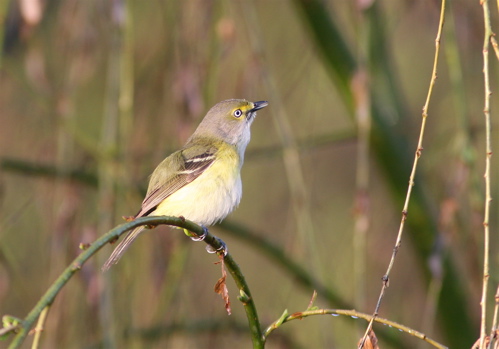 White-eyed vireo
White-eyeds sing a ton during courtship, then not at all during nesting it seems. I wonder if the tree-top-loving red-eyeds and yellow-throateds sing more regularly (or the white-eyeds less) due to their relative exposure to predators. A red-eyed vireo singing in the top of a tulip poplar is very hard to find. A white-eyed may be skulking in the shadows, but it's usually at eye level or below in a patch of brushy habitat. Does this make them more susceptible to predators?
 Yellow-throated vireo
Now that fall migration has started, these vireos can still be heard singing, though with nowhere near the intensity of the earlier seasons. The other notable behavior of fall migration is the aggressiveness of the red-eyed vireos. They zip and swoop from tree to tree, often chasing other birds. I imagine these other birds thinking "What the heck? Leave me alone!" I'm sure this behavior has something to do with the fluctuation in hormone levels brought on by the end of the breeding season and the onset of fall migration.
The red-eyeds remind me of teenage boys who, when they find themselves just standing around doing, nothing get the sudden urge to punch a nearby shoulder. This punch often elicits another, and so on.
Our vireos' aggressiveness sometimes pays nice dividends, like this morning when a pair of (probably young) red-eyeds chased two warblers out of deep cover in our sycamore tree: one was an adult male black-throated blue (my favorite North American warbler) and the other was a yellow-throated warbler—both firsts for this fall.
 Philadelphia vireo
Listening to the Predawn Morse Code
 Red-eyed vireo.
The leaves may still be green, and the insects in full voice. The bluebirds are still feeding nestlings, the meadow is still dotted with blooming wildflowers, and the kids have yet to head back to school, but the seasons are changing.
I was up very early this morning—before light—and when I stepped outside, the still morning darkness was broken ever so slightly by the Morse code of migrant birds overhead, whispering their contact calls to their fellow travelers.
 Nashville warbler.
I'm sure there were thrushes, and some sparrows, perhaps a vireo or two. And I'm positive I heard a warbler. I wish I knew these small, little-heard vocalizations better.
Dawn arrived yet none of the passerines dropped into our trees. So the mystery lingers. But tomorrow is another day with another dawn. And I plan to be up and out and listening expectantly in the darkness.
Doughheads
 Blue jay.
The birds at our feeders LOVE the homemade suet dough we provide. We feed it to them in moderation, so there's no concern about them getting obese, lazy, or addicted, but they ARE often waiting just after dawn in the willow tree off the back deck. They perch there, shifting from foot to foot nervously, wiping a wing across their beaks as they sniffle, eyes glazed. Their mood is very anxious, jumpy. They stare into the house through the sliding glass doors. They are waiting for "the man." Some mornings it is "the woman." To bring them their "medicine."
These are the "doughheads."
The second we open the back door to start the morning feeding frenzy, the doughheads make a big show of flying away. But they only go far enough to be in a good position to swoop in first to the fresh handfuls of dough on the deck rail and in the hanging dough feeder.
Here are a few of the most avid doughheads.
 Female red-bellied woodpecker.
 Male dark-eyed junco.
 Male northern cardinal.
 Female northern cardinal.
 Shy male eastern bluebird.
 Male house sparrow.
LBOTY and FBOTY

My last bird of 2010 was a whinnying eastern screech-owl, calling from the north border of our farm. I heard it at about 10:50 pm on New Year's Eve, while spending some time around a camp fire with my family and some dear friends. The owl was calling so softly that it was really hard to discern, even though the night was pleasingly still and quiet. It seemed a fittingly subtle and mysterious species to be the last bird of the year (or LBOTY).
 My first bird of 2011 was a male northern cardinal in the same tree as this photo and in almost exactly the same pose, minus the snow.
I make a big deal out of the first bird of the year. Sometimes I even go to great lengths to make it a special species. However this year I was feeling rather Zen about it and decided to just let it happen.
And, as it did happen, my FBOTY was Mr. Reddy. He was waiting patiently for SOMEONE to fill the bird feeders, and he successfully guilted me into it.
Thanks for stopping by to read my posts here during the past five-plus years. And thanks even more for all of your comments and kind words.
Here's wishing you a wondrous, healthy, happy, and bird-filled 2011!
—Bill of the Birds
Fall Migration: It's Starting!
 I walked into Julie's studio yesterday afternoon to ask her something and a flash of zippy-swoopy movement in the birches just outside the windows caught my eye. I knew right away it was a warbler and not one of the 27 goldfinches, dozen titmice, or half-dozen chickadees that were flitting from trees to feeders to bird bath.
But how did I know it was a warbler?
I'm not completely sure. There are clues that the human brain can gather, sort, and decipher in a matter of milliseconds. All I saw was one quick swoop from one birch to another and my brain instantly said "Warbler!" If I had to 'splain it, I'd say it was something about the size, color, and style of movement—all things that I'd seen before, deduced, and confirmed. But I'm only grasping for an explanation here. All I know is that I instantly knew what family that feathered thing belonged to, and I was determined to see it better.
 The warbler, in a show of fair play, hopped from the back of the bird tree to our side, which sent us scampering for binoculars and cameras. It was a female yellow-throated warbler! And this surely signalled the start of fall migration—in late July!
 For the next 10 minutes we watched her glean insects and tiny caterpillars from the birch leaves. Man, our gray birches ALWAYS deliver the warblers. This might be the single most bird-friendly tree species on our farm, even though they do not do well in our clay soil and hot, dry summers.

Each late summer through mid-fall we get our annual influx of yellow-throated warblers. They nest down along the creek on Goss' Fork and after the breeding season is over, they come a-hill-toppin' up to our ridge top farm, looking for food or perhaps just exploring before the start of migration.
One of our first falls here at Indigo Hill, as we were out on the deck enjoying a fine morning of birding, a male yellow-throated warbler dropped out of the sky and landed on our stone chimney just two feet from us. It then flew to the deck railing a foot from us. Then it landed on the tripod leg two inches from my knee. It cocked its head as if to make certain we noticed his fine fall plumage, newly molted in for migration. Then he swooped over to our newly planted sycamore. This last act was almost too much for me—I grew up calling this warbler by its original name sycamore warbler.
 My final view of Lady Sycamore, just before she slipped away. I dig her golden slippers!
After I left Julie's studio, heading back downstairs to do some podcast recording and editing, a young male American redstart and a female cerulean warbler also came through the birches. I missed them, but I certainly didn't miss the start of fall migration!
Pileated Nest Part Two
 Check out the swirling feathers of the female pileated woodepcker's crest!.
On the afternoon of May 15 I went back out to check on the progress of the pileated woodpecker nest I'd discovered in our orchard. Both birds of the mated pair had been sharing excavation duties and I wanted to see if they were still at work, or if egg laying had begun.
Soon after I entered the blind, the female flew in to the tree with the nest cavity. Without a sidewards glance, she entered the hole and started bringing out chips and dust from the bottom of the cavity. I noticed that I heard no loud hammering when she was in the cavity. A day earlier, I'd watched the male at the site and when he was inside, the hammering was loud and he emerged with chips rather than dust.
 When the female reached to the bottom of the cavity to scoop up chips and dust, just the tip of her tail was visible.
I heard a loud drum from the deep woods to the southwest of the blind, followed by a pileated's contact call. Moments later the female exited the nest and flew off in the direction of the call.
The male came back next and continued his excavation. He chiseled for a while then brought several bill-fulls of chip up to the hole and let the breeze blow them from his open bill.

At one point he stopped to rest and seemed to notice my spotting scope sticking out of the blind's peephole. He stopped and stared. Turning his head left and right, he look the scene over very carefully.
 The male was quite wary while in the nest.
He seemed to relax after a few minutes (and so did I) but he did not resume working. Instead, perhaps due to the heat of the afternoon, he began to pant with his bill open.

When the breeze would rise in force, the male would raise his bill—was he letting cool air flow across his throat and chest? I'll never know, but this seemed plausible.
 He might have just been looking around, or he might have been trying to cool off in the breeze.
He closed his eyes and took a few short naps, so I knew he was unconcerned with my presence. This made me happy because I was looking forward to watching the entire nesting cycle—if these birds were lucky enough to nurture a brood from hatching to fledging. The huge, yellow poplar they'd chosen as a nest site was broken off on top and it was missing some of its bark, but there was no real impediment to prevent a hungry raccoon from climbing up to the cavity and making a meal of the eggs.
 Male pileated woodpecker catching a few winks.
I'll revisit the pileated nest in some future posts. But right now I've got to go scouting for a Big Day field trip I'm leading tomorrow.
Langganan:
Postingan (Atom)


