Tampilkan postingan dengan label leucistic birds. Tampilkan semua postingan
Tampilkan postingan dengan label leucistic birds. Tampilkan semua postingan
Weird White-tailed Grackle
 This weird-looking dude showed up at the platform feeder a couple of weeks ago. He's a leucistic common grackle. What caused his tail to be white is anyone's guess. Was it a flaw in his genetic material? The result of an injury or some dietary anomaly while a nestling? A fashion statement?
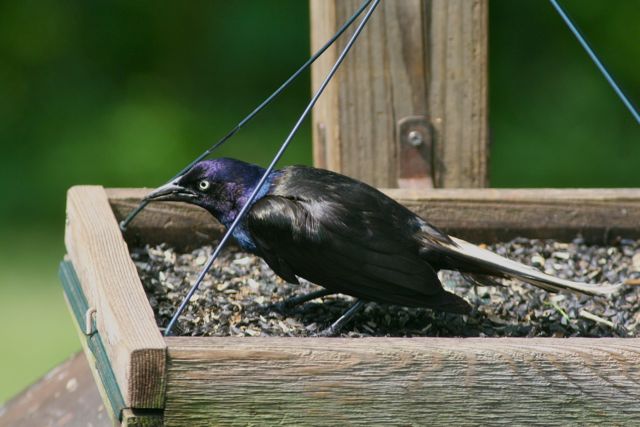 It's been a big blackbird year around the farm with larger-than-normal numbers of red-winged blackbirds and common grackles hanging around, visiting the feeders, foraging on the lawn.
I always enjoy it when we have these "marker birds" around—birds with a noticeable and often odd physical attribute. We've had bluebirds with a drooping wing or messed-up alula feathers. We've had a partially white junco. For one winter we hosted a tufted titmouse with an overgrown upper mandible. These are all birds that are easy to notice and keep track of because their physical anomalies make them stand out as individuals.
The current issue of Bird Watcher's Digest features an article about a juvenile rose-breasted grosbeak that lacked a beak! If the photos of this rose-breasted no-beak don't freak you out, try watching the video in our digital edition. Freaky!
By the way, here's your obscure fact for the day: Albinism in birds is caused by an absence of melanin in the feathers and body. This usually results in birds that are totally white with red or pink eyes. Leucism is caused by uneven distribution of melanin in the feathers and body, resulting in pale-looking birds or birds with patches of white.
Our white-tailed common grackle (which is leucistic, not albino) stayed around for a few days and then moved on. But if he returns, we'll certainly notice.
No Snowflake The Junco

Snowflake at the suet dough in February 2008.
Some of you might remember my posts last winter about Snowflake the leucistic adult female dark-eyed junco who was a winterlong visitor in our yard.
Well, Snowflake did not show up in October, when the first returning juncos did. And now, it's December and we've got at least 30 dark-eyed juncos scattered around the various feeders and fields—but all of them have normal-looking plumage.
Which makes me wonder what happened to Snowflake. Did she make it through the spring and summer and now is spending this winter somewhere else?Did a sharp-shinned hawk get her? A house cat? Did she collide with a radio tower? Did she die of natural causes?—most passerines are lucky to survive more than just two years. Or is she just not back here yet? I'm hoping it's the last one on that list.
Dark-eyed juncos are considered short-distance migrants. The distance between their boreal forest breeding range and their wintering range pales in comparison to the migration of a blackpoll warbler, which also breeds in the boreal forest but migrates to South America. Most juncos spend the winter within the United States and Canada. Some juncos, such as those that I see in the West Virginia mountains each spring, don't migrate at all.
 We've got plenty of "normal" juncos around this winter.
We could always tell Snowflake because she looked more like a snow bunting than a junco. She was a perfect "marker bird"—a bird with an obvious and unique physical character that allows you to identify it as an individual. Otherwise, most individual birds of a single species are hard to tell apart, unless you get a really close look and spend some time looking for subtle differences.

Snowflake looked like a snow bunting at first glance.
Marker birds allow you to be sure you are seeing the same individual bird. Last winter I was home a lot finishing up a book project, so I got to know Snowflake's routine. In the morning she was in the weedy edge along the orchard. In late afternoon she'd come to the deck railing around back for some suet dough. At night she roosted in the brambles along the spring trail, down the hill behind our house.
Sitting here at my desk today, watching the snow dance down, I can see a small pod of juncos kicking through the mixed seed under the pines. I'd like to look out and see a mostly white one for the third winter in a row. Guess I'll keep watching and hoping.
Langganan:
Postingan (Atom)


